CBS

Showing posts with label Biography. Show all posts

Tuesday, November 22, 2011

Remembering Mark Lenard

Fifteen years ago today we lost Mark Lenard.  I thought it appropriate to remember him here by exploring his life and career.
Mark Lenard was born Leonard Rosenson in Chicago in 1924.  Having graduated high school in 1941, Lenard joined the army in 1943 and served as a paratrooper in Europe.  During his time in Europe, he starred in a Ben Johnson play called Volpone which toured for soldiers.  After being discharged in 1946, Lenard lived in New York where he studied to become a writer.  However, in the late 1950s and early 1960s, Lenard began to take roles in various off Broadway plays.  He discovered a talent for acting and began to take acting classes.  In one of these classes, he met his future wife, Ann Amouri.  They were married in 1960 and later had two daughters.

Lenard had roles on television beginning in 1959 and he continued working until 1993.  His first feature film performance was as Balthazar in The Greatest Story Ever Told but the following year--1966--Lenard began the work for which he is best known on Star Trek.


Lenard was cast as the Romulan Commander in the first season Star Trek episode "Balance of Terror."  Along with Lawrence Montaigne (Decius) he has the honour of being the first Romulan to appear in Star Trek.  His performance and presence were so strong that when Roddenberry was casting the role of Spock's father Sarek for the second season episode "Journey to Babel" Lenard was at the top of the list.  "Journey to Babel" aired in November 1967 and for the next 30 years, Lenard would be best known as the Vulcan, Sarek.


In the 1970s, amongst many other roles, Lenard voiced Sarek in the Star Trek: The Animated Series episode "Yesteryear" and again leant his voice to the character in an LP release called Inside Star Trek in which Gene Roddenberry interviews Sarek about the origins of Spock.


In 1979, when Sarek did not fit into the plans for Star Trek: The Motion Picture, Lenard was given the role of the Klingon commander.  In this role he had the honour (pun intended) of playing the first Klingon with forehead ridges and also the first Klingon to speak the Klingon language.  Now, Lenard had helped to create three of Star Trek's most important alien species.


Lenard reprised his role in three of the Star Trek feature films.  In Star Trek III we see a more tender side of Sarek as he mourns the death of his son and tries desperately to resurrect Spock.

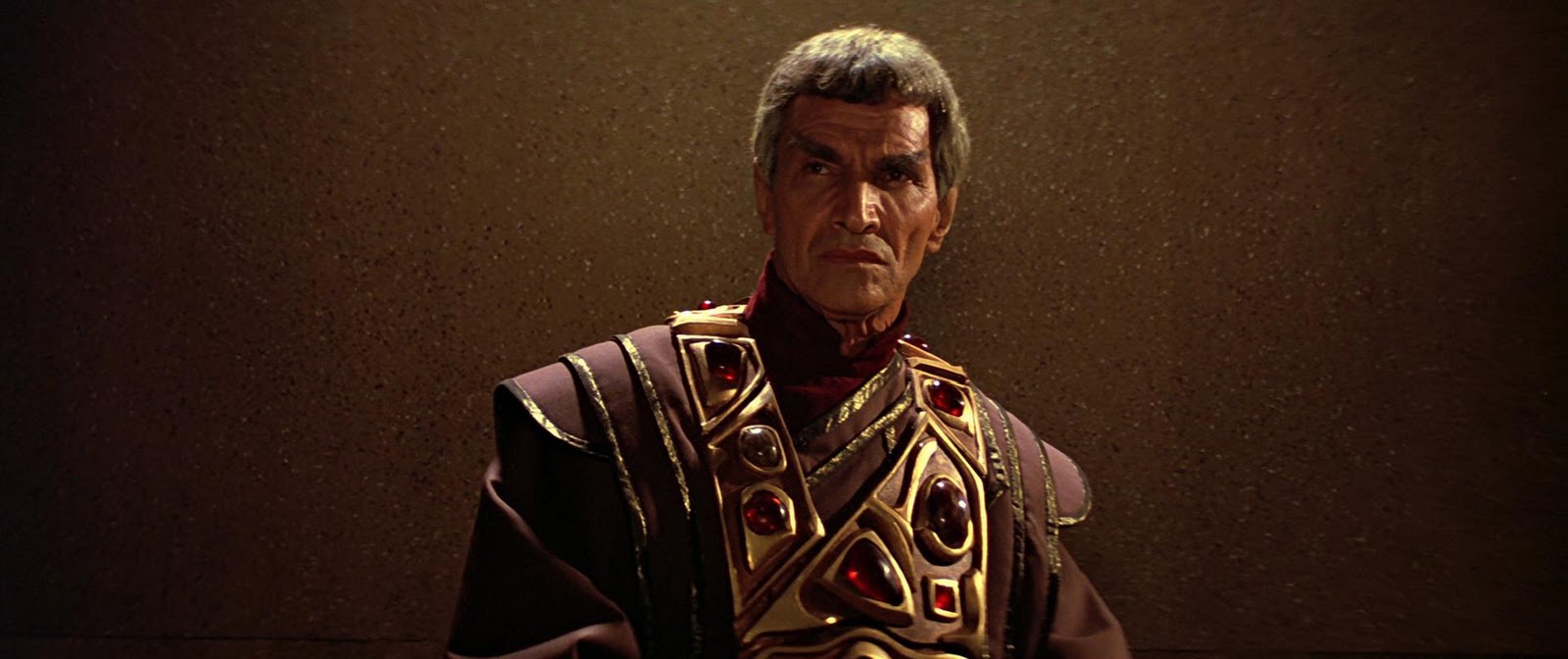
In Star Trek IV and VI, we see Sarek in his role as Vulcan ambassador to the Federation.  He displays fierce loyalty to his son and the crew of the Enterprise but also unfailing logic in his diplomatic role.


Before appearing in The Undiscovered Country, Lenard made two appearances as Sarek on Star Trek: The Next Generation.  He appeared in the third season episode appropriately titled "Sarek" and then in the fifth season episode "Unification, Part 1."  These appearances showed Sarek 80 years older in the 24th century, still a celebrated ambassador, but unfortunately ailing from a condition called Bendii Syndrome.  This condition affects the minds of older Vulcans, making it extremely difficult for them to continue to repress their emotions.


I found it very difficult to see Sarek in this frail and declining form and when the character finally dies of Bendii the repercussions are felt not only throughout the Star Trek universe but also throughout Trek fandom.

Sarek was a man of strong beliefs.  On the surface, his logic was the most important thing to him, yet this was a man who had twice married human women.  He lived his life with emotional humans and went to great lengths to have a son with Amanda Grayson.  Lenard's performance brought a sense of gravitas to the role of Sarek that made the character, and even the Star Trek universe itself, deeper and more believable.  It should therefore not surprise us that Lenard was a successful acting teacher throughout the 1980s and 90s.

In 1994, Mark Lenard was the first actor I ever met at a Star Trek convention (Odyssey Trek in Niagara Falls).  This ended up being one of his final appearances.  In October 1995, Lenard began to experience fatigue and pain in his ribs and back.  He was diagnosed with Multiple myeloma which is cancer of the plasma cells.  His illness continued to worsen until he died at the age of 72 on November 22, 1996 (the same day Star Trek: First Contact was released). He was survived by his wife and daughters.  Though he left this world at too young an age, Mark Lenard will be "immortal" through his many memorable roles in film and television and especially as Sarek.


I hope all Vulcanologists will take time today to reflect and remember Mark Lenard and the father of Spock.

Saturday, October 16, 2010

Michael Kaplan's New Universe Vulcans

Michael Kaplan has been working as a costume designer since 1982.  In 1983 he won the BAFTA Film Award for best costume design for his work on Blade Runner.  Since then, he has frequently worked on science fiction films from Armageddon and Pearl Harbour to Star Trek (2009).  Kaplan had a unique challenge to overcome when J.J. Abrams hired him to design the costumes for Star Trek (2009).  He had more than forty years of design history to either be faithful to or disregard.  In the end, I think he did a good job at finding a balance.  His revamped Starfleet uniforms are perfect; combining enough of William Ware Theiss' original design with new tweaks for the 21st century.  Of course, I'm most concerned with his Vulcan designs.
Kaplan's Vulcan designs are a bit of a departure from what we've seen in previous films and series.  Most of them favour a decidedly asymmetrical style and the fabrics are muted earth tones.  Where most previous Vulcan costumes use metallic fabrics and feature jewelry or symbols, Kaplan's Vulcans are much simpler and less-flashy.  That sort of makes sense given the Vulcans are meant to be logical, practical people.  It should also be noted that most of the previous Vulcan costumes we've seen were worn by diplomats and religious figures and the Vulcans in Star Trek (2009) are mostly scientists and educators.  That might account for the differences in taste.

I really like Kaplan's design for the Vulcan students' costumes seen near the beginning of the film.  They're striking and alien yet not alien enough to seem out of place.
Kaplan's design for Spock's mother, Amanda, definitely feels like it belongs in the same world as the Vulcan student designs.  It features the same long, body shape but it is feminized with a flowing scarf and with warm colours.
Kaplan's designs for Spock are simple and appropriate.  They don't draw attention away from Nimoy's performance but they're "sci-fi" enough to be memorable.
Aside from the new Starfleet uniforms, probably the most memorable of Kaplan's costumes for this film is Spock Prime's parka.  It's a beautiful costume.  One of them has toured North America as part of the recent traveling Star Trek exhibits.  Another was sold at the recent Julian's Star Trek auction.
Kaplan also created a host of Vulcan costumes for the extras who performed as scientists and engineers building the Jellyfish ship, the Vulcan elders from the Katric Ark and the council from the Vulcan Science Academy.  Some of these, notably the female costumes, share similarities with the collars of the Vulcan student costumes.  A few of these costumes have also toured around the United States to help promote the film.
Overall, I think Kaplan did a great job costuming Abrams' film.  Collectors will be very excited when more of his costumes become available for sale someday.

More information about Kaplan's work can be found in Mark Cotta Vaz's book, Star Trek: The Art of the Film.

Monday, September 20, 2010

Nilo Rodis: Costumes From the Final Frontier

Nilo Rodis (or Nilo Rodis-Jamero) worked at ILM in the 1980s.  He served as a visual effects art director on The Empire Strikes Back, Raiders of the Lost Ark and Star Trek III: The Search For Spock.  He is credited as the designer of the popular Klingon Bird of Prey first seen in Star Trek III.  He went on to work as a costume designer for Return of the Jedi and as an art director on Star Trek IV, V and VI.  When William Shatner saw the detail that Rodis put into his storyboards for Star Trek V: The Final Frontier, he hired him as a costume designer.  He shared those duties with Dodie Shepard.
Nilo Rodis in the Star Trek V DVD Bonus Features

In his designs for Sybok, Rodis displays his knowledge of Vulcan design from previous Trek films.  I really like that he put so much emphasis on including triangular shapes.  Triangles have been important visual cues in Vulcan design since William Ware Theiss created the IDIC for TOS.  Designers in for ST: TMP continued the trend and brought it into Vulcan architecture.
Robert Fletcher continued to develop the idea with his costumes for Spock in ST: TMP and for T'Lar in Star Trek III.  
Here are some sketches and a storyboard featuring Sybok by Nilo Rodis.


Maintaining these kinds of design archetypes really helped Star Trek continuity over the years.  Vulcans are easily distinguishable from Klingons, Romulans and everyone else because of design tricks like this.  These designs provide Vulcan clothing with a sense of geometrical order which seems to me, perfectly logical.  The resulting costume for Sybok displays echoes of the previous designs so he can be identified as a Vulcan even though he's the most different Vulcan we've ever seen.
After Star Trek VI, Nilo Rodis has continued to build a rich career in design for film.  Most recently, he served as visual effects art director on Tim Burton's Alice in Wonderland.  His attention to detail is a trait shared with most Trek designers and one of the things that allows Star Trek's designs to hold up so well over time.

A good source for more of Rodis' work is The Art of Star Trek by Judith and Garfield Reeves-Stevens.

Friday, September 10, 2010

Remembering Mike Minor

Emmy Award-winner Mike Minor is another of the incredible Star Trek artists who is not well-known but deserves to be!  He was born on September 25, 1940 and one of his first Hollywood jobs was working as an artist on Star Trek: TOS beginning in 1968.  He was responsible for designing the Tholian Web from the episode of the same name and the Melkotian from "Spectre of the Gun."  Minor also created many of the wall paintings and diagrams seen on the USS Enterprise.  He went on to work on fan favourites like The Beastmaster and The Man Who Saw Tomorrow and won his Emmy for visual effects on The Winds of War.
Mike Minor in 1979 (note the Trek art above him)

Years later, when Gene Roddenberry began developing Star Trek: Phase II, he hired Minor as a conceptual designer.  Minor contributed to the overall design of the new USS Enterprise and also to many of the interior sets including the Bridge, Sickbay and Engineering.  Many of his designs remained intact when Phase II became Star Trek: The Motion Picture.  Moreover, many of his designs influenced those who designed Starfleet sets for the next 30 years.  It is for Star Trek: TMP that Minor contributed to Vulcan design.

Minor worked on designing the planet Vulcan for the scene where Spock addresses the Vulcan Masters.  Recently, Rick Sternbach sold four original pieces of Minor's art for this sequence on eBay.  This is the first time they have been seen by the general public because they have been in his private collection since Minor gifted them to him in 1979.
Most of this sequence was shot in a large outdoor tank at Paramount.  It's clear from this illustrations just how much influence Minor had on the design of this set.  
Sternbach remembers that "...Mike was frequently out in the middle of the Paramount lot in front of the giant "B" tank, directing where the foam spray gun guy was to point his nozzle (to make the hot springs landscape), and wrangling the giant red fiberglass feet of the statue with the staff shop crew."  He says that "Mike was truly enthusiastic about SF and film; he knew a great deal about its history, knew a lot of people in the business, and had a great design sense."

Famous Hollywood curator, Bob Burns, was good friends with Mike Minor.  Burns remembers "Mike Minor was like my younger brother. My wife and I meet him when he was 18 years old and immediately became the best of friends and were until the day he passed away. It still hurts till this day. Not only was he incredibly talented he was also one of the greatest people on the face of the Earth."  Mr. Burns went through his archives for me and dug up this rarely seen piece of work by Minor.  The top image is an actual photo from a shoot at Yellowstone.  The foreground is a detailed miniature that was suspended in front of the camera.  The lower image was modified by Minor featuring a beautiful background painting that was, unfortunately, not used in the final film.
The completed shot is different from what Minor originally proposed but his influence is obvious.  Here are two different versions from different editions of the film.


That red head that appears so mammoth on screen was actually a miniature about 8 inches across.  It was made of resin and recently sold at the Profiles in History Hollywood Auction 40.

Rick Sternbach worked with Mike Minor and Bob Burns on Burns' 1979 Halloween Alien Extravaganza.  Sternbach remembers "Mike was essentially the production designer on that, and we all merrily glued and hammered and detailed the Nostromo set piece. Walter Koenig played Captain Dallas; it was a great deal of fun."

Mike Minor would have celebrated his 70th birthday later this month if he had not been tragically taken from the world too early.  He died of complications from AIDS in 1987.  It is to remember people like Mike Minor that I participate in the AIDS Walk For Life every year.  It has now been 30 years since this horrible disease was properly identified and it is still a worldwide pandemic.  Over 33 million people across the globe are living with AIDS now and it kills over 2 million people a year.  This year's walk is on September 19th.  If you can, please help by donating to the cause.

Though they're not Vulcan-related, I wanted to also share these images of Minor's art for Phase II and TMP.  They are from the collection of Bob Burns and have rarely been seen so clearly.


Mike Minor concept art for V'Ger

Mike Minor concept art for Main Engineering

Mike Minor concept art for a Spacedock


I would like to thank Bob Burns and Rick Sternbach for sharing their recollections of Mike Minor with me and for opening up their collections to share his art with us all.