CBS

Showing posts with label Symbols. Show all posts

Wednesday, October 25, 2017

Unpacking Michael Burnham's Graduation, Part II: Costumes, Jewellery, and Symbols


The costume designer for Star Trek: Discovery is Gersha Phillips. I discussed her work a little bit earlier this year when one of Sarek's costumes was on display at SDCC but we now have a treasure trove of work to discuss!
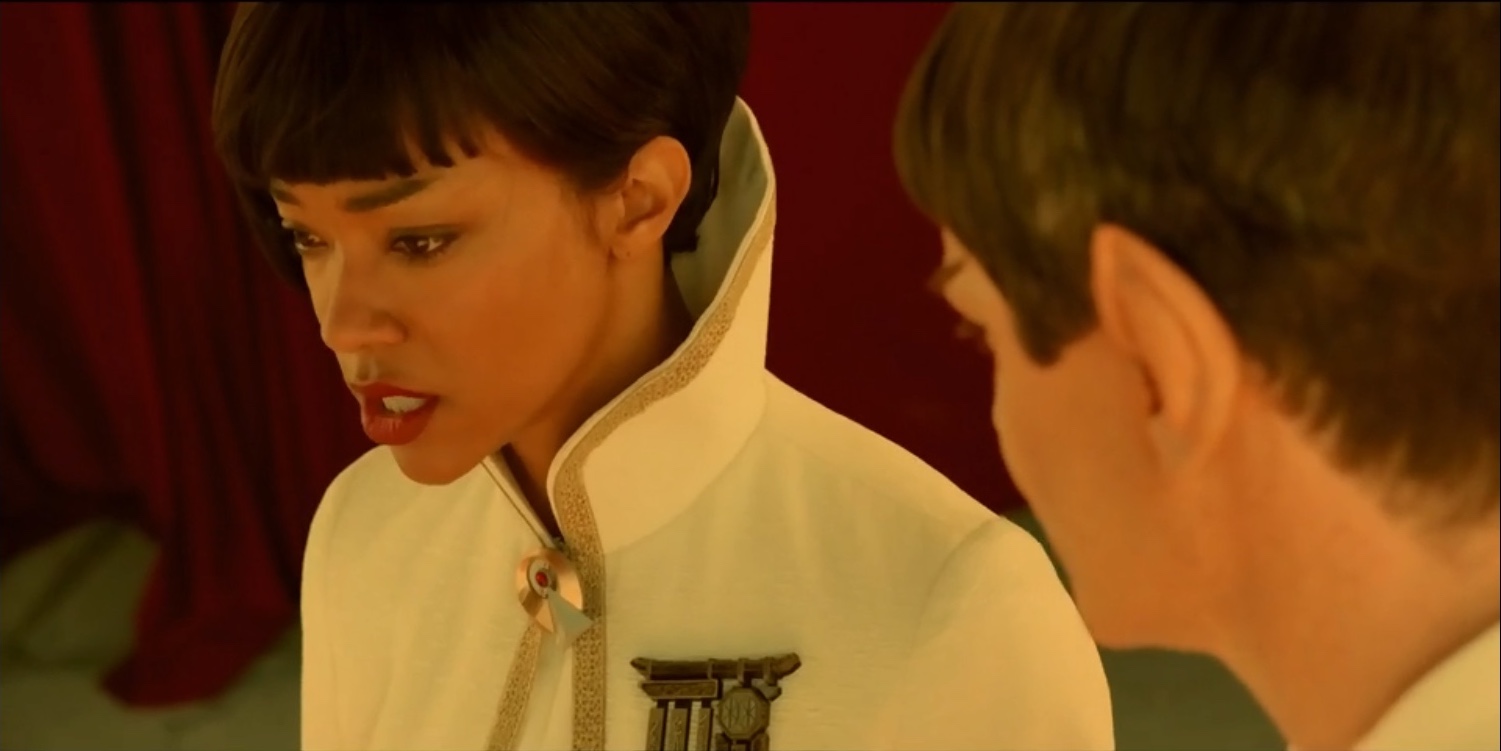


It seems to me that the Discovery Vulcans are influenced most by Michael Kaplan's Kelvin Universe costumes. The high collars, textured fabrics, and long, clean lines we see at Burnham's Graduation are very much in line with the Vulcans we saw in Star Trek (2009).
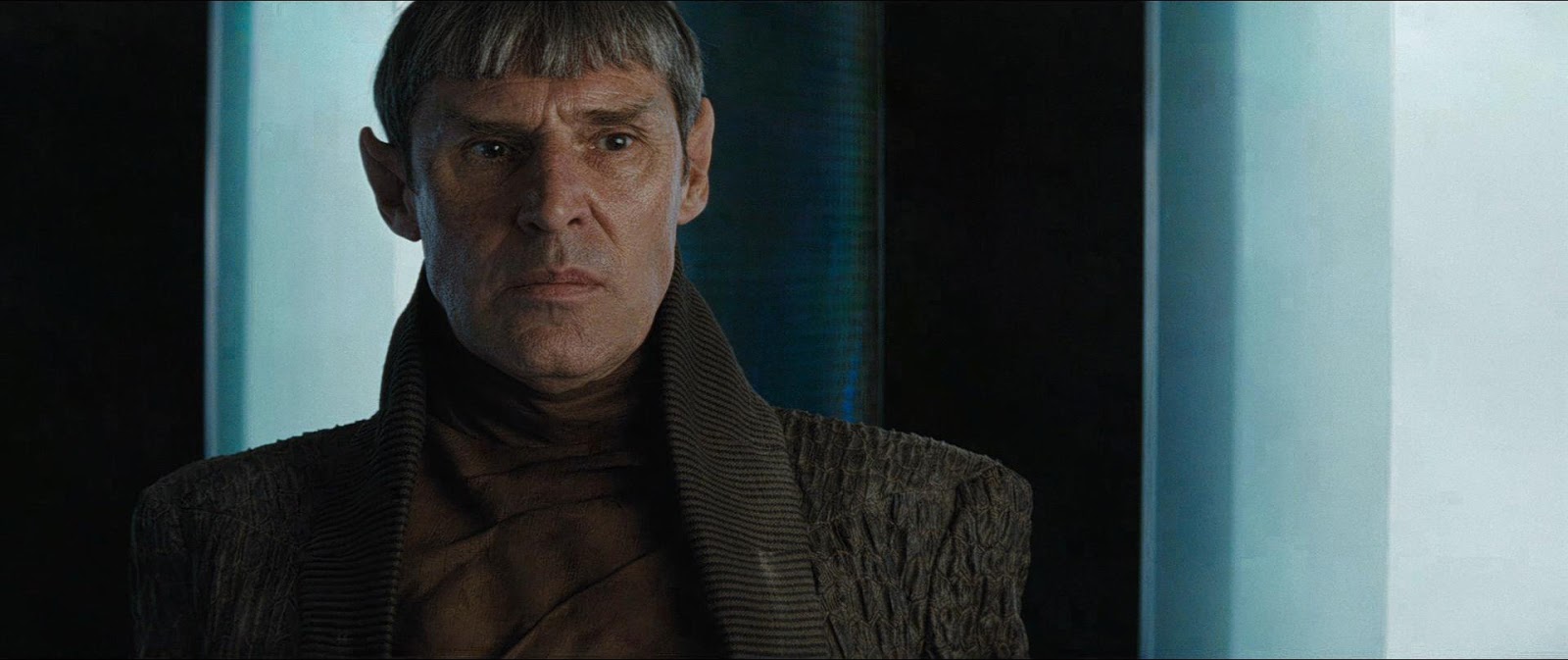

These costumes are much less ornamental than most of the Vulcans we've seen previously. The person who's designed the most Vulcan costumes is Robert Fletcher for the TOS films. Most of those were for religious or spiritual characters. The simpler styles we've seen from Kaplan and now Phillips seen to be largely for politicians and scientists.


Having said that, we do get some tantalizing glimpses of jewellery at Burnham's Graduation. Most of it is worn by female characters, including Burnham herself. The brooch that Burnham is wearing is clearly a reference to Spock's Kolinahr necklace from The Motion Picture.


It seems like the people dressed in white robes like Burnham's are the students who have just graduated. The woman to the left of the following frame is wearing a similar brooch but one that is less ornate. There are other graduates in the scene wearing the same brooch as Burnham. The variety of styles possibly suggests differences in academic standing. Burnham's more ornate brooch indicates her higher achievement.


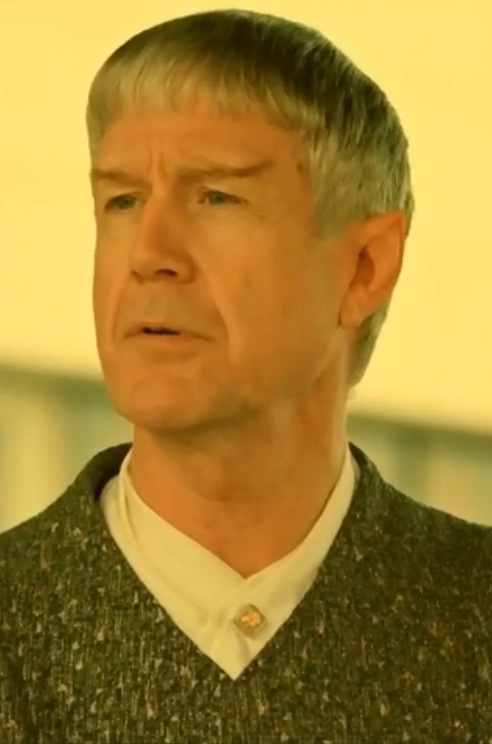
These graduates also wear IDIC pins at their throats. A pin like this was included in the SDCC exhibit. The Vulcan Director (Jonathan Whittaker) wears a small pin at his throat as well. I haven't been able to capture an image of sufficient quality to see the detail. It could be that there is no symbol on this and it is merely decorative.

The other jewellery in the scene is worn by Amanda Grayson (Mia Kirshner). Without more information it is difficult to know for certain, but I would say this jewellery looks Human rather than Vulcan.


Besides those we see on clothing, there are additional symbols we can pick out in this sequence.
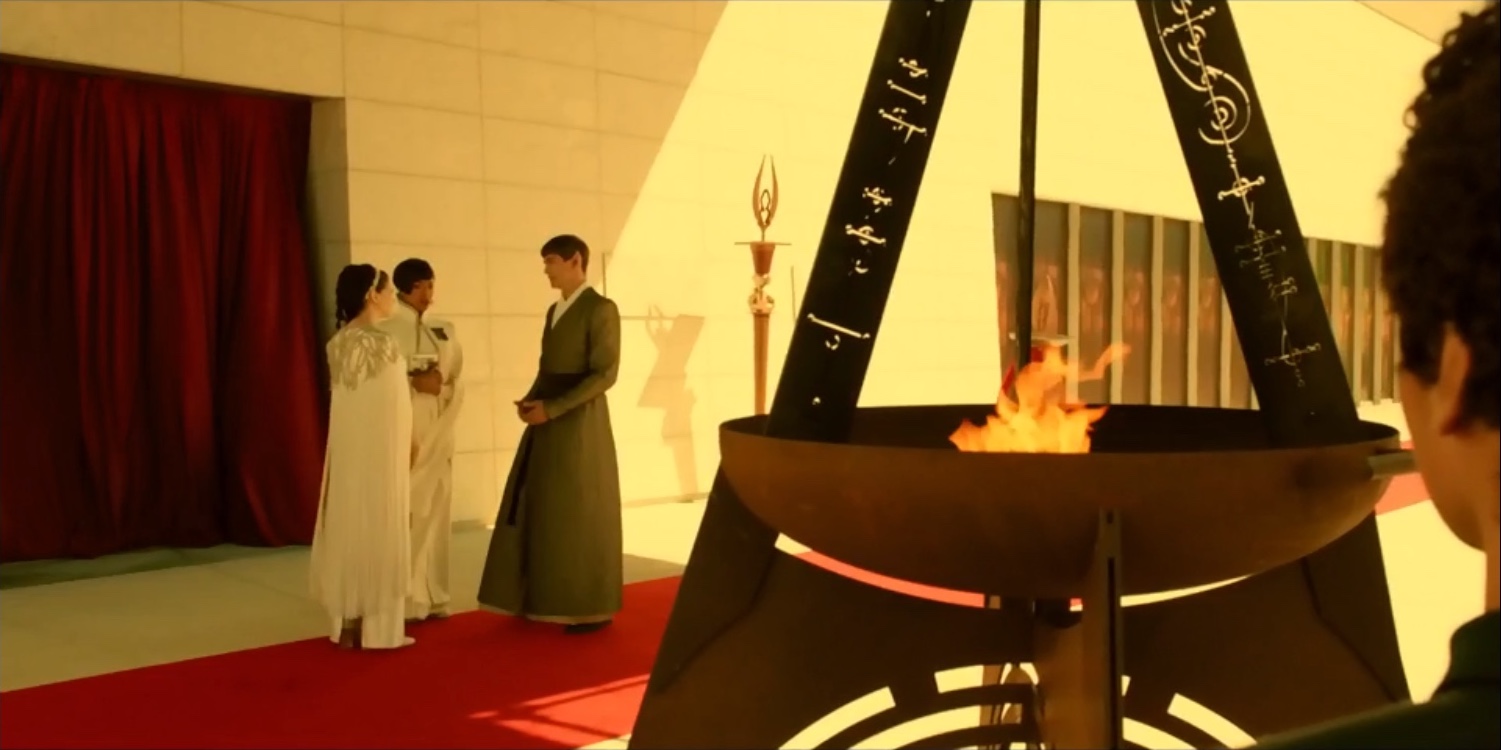

The metal sculptural pieces that I discussed briefly here are engraved with Vulcan calligraphic script. In previous Star Trek incarnations this script has not been given formal meaning. Fans like those working at korsaya.org have ascribed meaning to calligraphic symbols we have seen. It is possible that the Discovery team has used this fan work to inform what we see on screen. It's equally possible that these are simply decorative or that the Discovery team has created a system of meaning for them. We need more information to be sure.


There is still more information to unpack in Burnham's Graduation! Next time, I will discuss the props and ships we see in this sequence.

Thursday, June 8, 2017

IDIC: Happy Pride

June is Pride month! I have always felt the Vulcan philosophy of IDIC: Infinite Diversity in Infinite Combinations was a perfect message for this month. Happy Pride!


Queer IDIC by Bristrek


Wednesday, November 17, 2010

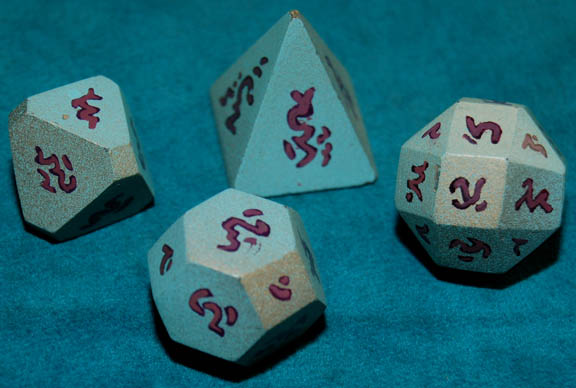
Vulcan Language Dice From "Unification"

A friend of mine from the Star Trek Prop and Costume Forum has agreed to let me share some great items from her Vulcan collection.  These were purchased in week 34 of IAW's eBay Star Trek auctions in 2007.
These are wonderful props because, although there were hundreds of Vulcan costumes created for Star Trek over the years, there were very few Vulcan props.  These were also handled by the father of all Vulcans, Spock (Leonard Nimoy).  In "Unification, Part II" a young Romulan named D'Tan (Vidal Peterson) brings these dice to Spock.  He tells Spock that they were his toys as a child and Spock tells him that they are very old and that the symbols form the syllabic nucleus of the Vulcan language.
The description of the symbols as being "syllabic" is in line with what little else we know about the Vulcan language.  It suggests that each symbol represents a group of letters or a sound.  Costume designer Robert Fletcher who designed the wonderful "trinity" of symbols often seen on Vulcan costumes has said that the symbols he created represented entire thoughts or ideas rather than letters.

Each of the dice is uniquely shaped; one is a pyramid, one an octahedron (8-sided), one a tetradecagon (14-sided) and one a icosikaihexagon (26-sided).
The five symbols on the pyramid


 The eight symbols on the octahedron


Fourteen more


 The final twenty-six

As far as I can tell, no symbol on the dice is duplicated exactly.  That means there are 53 individual symbols or sounds (phonemes).  Of course, we cannot be guaranteed that these dice represent a complete set so there could be more but 53 seems a reasonable number.  There are 36-44 phonemes in the English language (depending on dialects), Mandarin has a total of 56 basic sounds, other Earth languages have as few as 20 phonemes or as many as 60.  

The next step would be to assign each of the symbols a unique sound to begin to create the language.  Linguist Marc Okrand created a few Vulcan words for Star Trek II: The Wrath of Khan, however, he was limited because the dialogue had originally been recorded in English so he had to create words with sounds that seemed to fit the actors' mouths.  Hopefully, someday Okrand or other linguists will be given the opportunity to develop the Vulcan language as fully as Klingon has been.

The first photo in this post is credited to IAW.  The screencaps belong to CBS/Paramount and the close-ups of each symbol belong to my friend the photographer and owner of the dice.